-
Blog
- Reading time 4 min
The end of the traditional funnel: Why companies still selling in a straight line have already lost
There was a time when the sales funnel was a masterpiece of business logic. Attract, convert, and close. Simple, predictable, scalable. For decades, companies built their teams, technology, and culture around this methodology.
And it worked—until it didn’t. Not because the idea was bad, but because the customer changed, and the funnel didn’t.
The traditional funnel assumes something that is no longer true
The sales funnel was born in an era when companies controlled the information, setting the pace and the steps to guide a customer toward a buying decision.
Today, customers enter a sales conversation having already done their own research, compared options, read reviews, and, in many cases, made a preliminary decision.
They don’t want to go through the entire funnel; they want a fast, relevant response on the channel where they already are. In all of America, that channel is overwhelmingly WhatsApp.
What is happening in North America (and what many still fail to see)
The numbers are undeniable. Mobile commerce now accounts for more than 70% of all e-commerce traffic in the region, and text messaging has become the preferred touchpoint for modern consumers, with over 71% of users explicitly stating they prefer messaging over traditional web browsing for customer assistance. It’s no longer just an alternative communication channel—it is the default infrastructure for consumer engagement.
The commercial impact of this shift is already massive. The conversational commerce market in North America has surged to over $5.8 billion, capturing nearly 40% of the entire global market share. Powered by AI-driven chatbots and text-to-buy software, brands utilizing these platforms are seeing a 23% increase in final checkout conversion rates.
The companies that understood this first didn’t just use text channels to blast mass, one-way promotional discounts. They used it to build automated, highly contextual 1-on-1 sales flows, answer product questions in real time, and close complex deals directly through SMS or Apple Messages for Business—without ever forcing the customer to leave their messaging screen.
The result wasn’t just operational, it was commercial: customers who came in with a question ended up making a purchase. That is a conversation that sells!
The straight line never existed
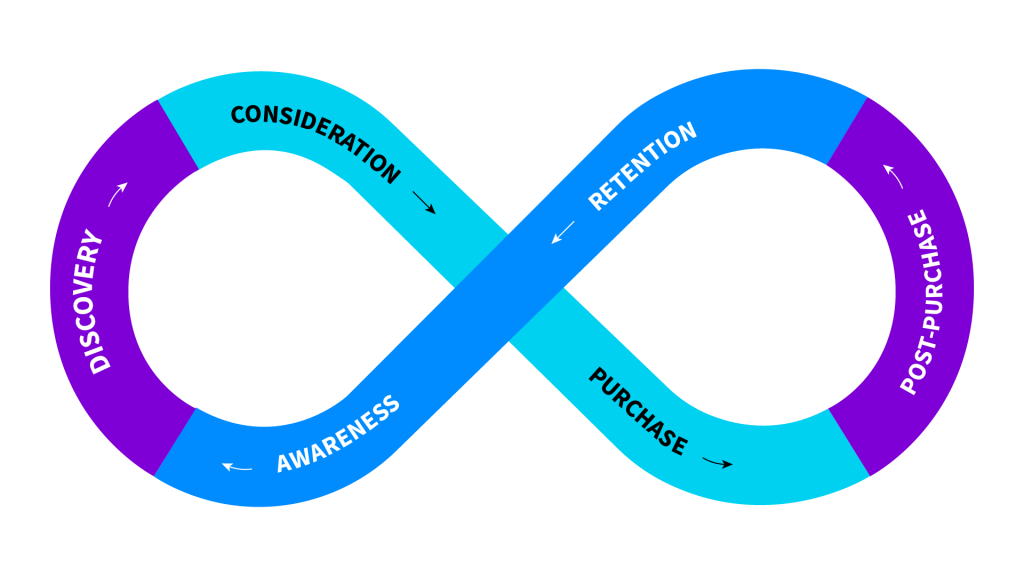
Real customers don’t move in a straight line. They research, leave, come back, ask questions, hesitate, compare, read reviews, consult with friends or family, and only then do they decide. The funnel was a useful simplification for internal teams, but it never reflected the customer’s reality.
Conversational commerce didn’t invent a new behavior; it recognized it. And it built technology to meet customers exactly where they are, instead of forcing them down a path designed for the company’s convenience.
The new circular funnel
If the traditional funnel was a straight line downward, the new funnel replaces that linear model with a circular one, where continuous service drives new sales. The customer enters, leaves, returns, and every conversation is an opportunity to deepen the relationship, eliminate friction, or close a sale.
72% of Latin American consumers have made at least one purchase through a messaging app, compared to 45% in Europe and 38% in North America. The companies winning in LATAM are those having timely conversations with their customers throughout their buyer’s journey.
Many retailers have integrated a conversational agent into WhatsApp or other digital channels to reduce cart abandonment rates. This tool provides guidance and is present at the exact moment a customer needs help making a decision.
The infrastructure that makes it all possible
Behind every conversation that sells, there is a platform that allows companies to connect with their customers at scale through automation, CRM integration, and multi-agent support.
Accessing this requires partnering with an official Meta-validated Business Solution Provider (BSP), which acts as an essential bridge by providing the technology, software, and expertwww.onemarketer.netise needed to connect companies to the platform. That is exactly what we do at OneMarketer.
This matters because not all conversations are created equal. A well-orchestrated conversation, with the right context and at the perfect moment, is what transforms a message into a sale. At OneMarketer, as a certified Meta BSP, we have spent over 10 years building exactly that for leading companies across the region.
What does this mean for your company?
If you are still measuring your commercial process in funnel stages, it’s not just that you’re behind—it’s that you’re reading the wrong map.
The questions that matter today are not about technology; they are about commercial strategy:
- What channels is your customer having conversations on today?
- How long does it take your company to respond to a sales inquiry?
- How many sales are lost because no one is available when the customer finally has time to make a decision?
- Do your conversations have context, or does every interaction start from scratch?
The future isn’t a more sophisticated funnel. It’s a smarter conversation.
At OneMarketer, we have spent years helping companies in the region transform their sales processes into conversational experiences that sell, retain, and scale. As a certified Meta BSP, we have direct access to the technology and the backing to do it right.
If you want to explore how to apply this to your business, let’s talk.