Blog · November 12, 2026
Agentic orchestration: one agent directing the specialists
What an orchestrator agent is, which specialist agents support it, and how OneMarketer combines them to resolve conversations end to end.
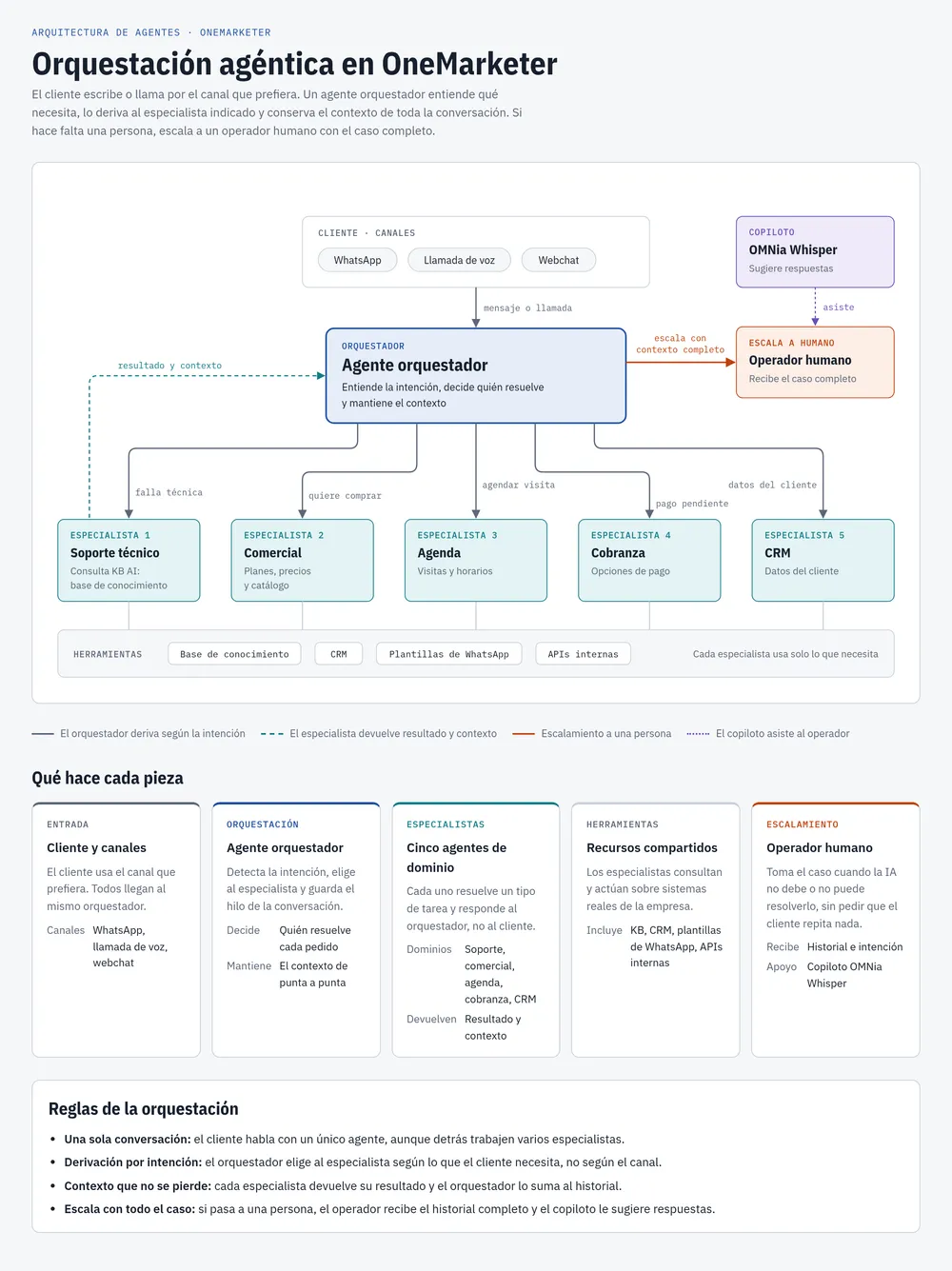
One AI that knows everything sounds great, but in real operations it rarely works. When a single agent must diagnose faults, sell plans, book visits and negotiate payments, its prompt grows huge, it gets confused and it becomes hard to maintain. The alternative is agentic orchestration: a team of agents, each with a clear job, coordinated by one that directs.
What is an orchestrator agent?
The orchestrator agent is the conversation’s traffic director. It does not solve everything itself. Its job is to:
- Understand the customer’s intent from the first message or the first sentence of the call.
- Decide who should resolve it and hand the conversation to the right specialist.
- Keep the context so the customer never has to repeat their details.
- Escalate to a person when the case requires it, with the full history at hand.
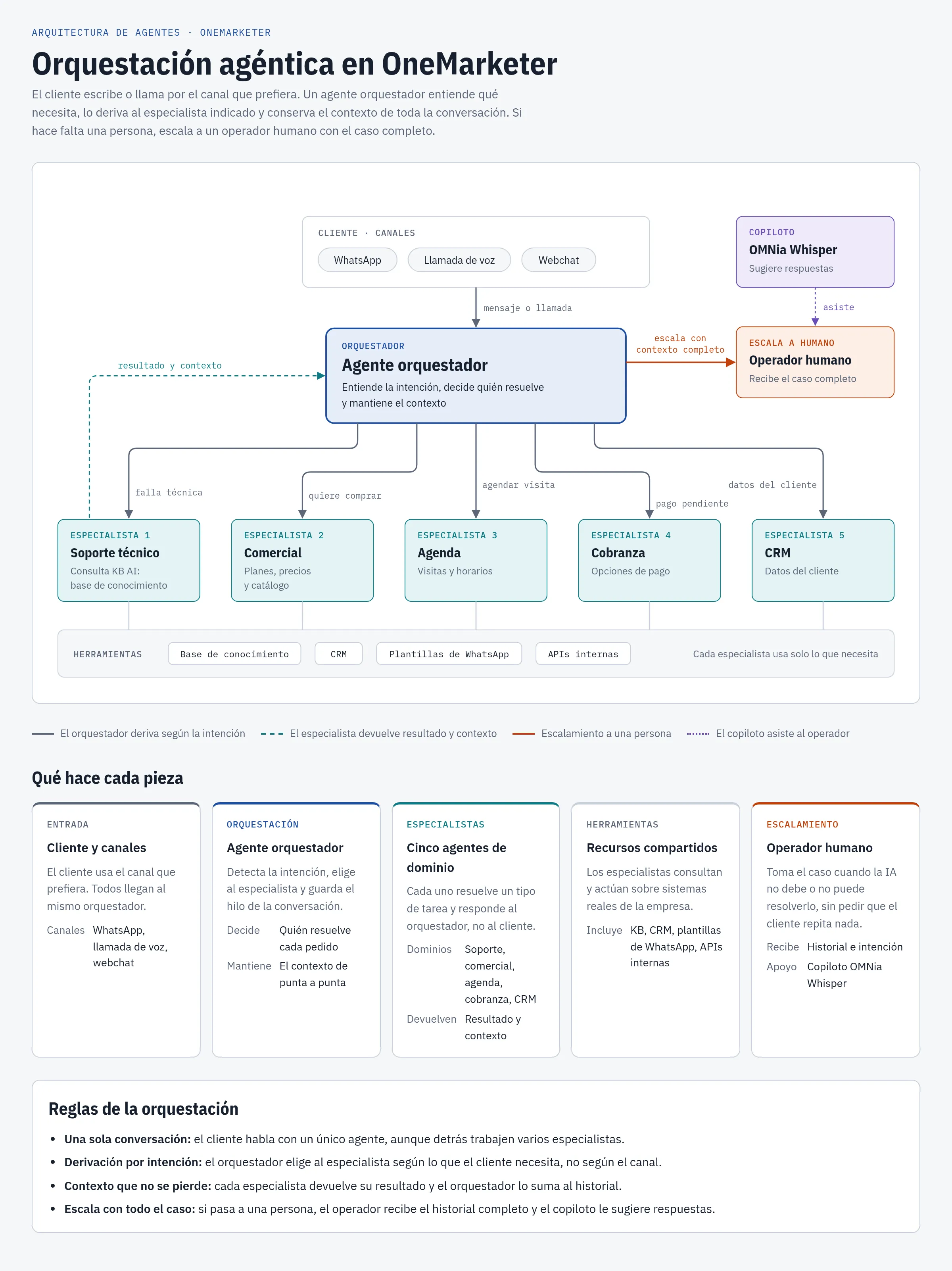 The orchestrator receives the customer on any channel and routes to the specialists.
The specialist agents
Each specialist has its own prompt, model and tools, and does one thing well:
- Technical support: queries the knowledge base (KB AI) and guides the diagnosis step by step.
- Sales: answers about plans, prices and promotions using the real catalog.
- Scheduling: offers available time slots and confirms visits.
- Collections: presents payment options within defined ranges and sends the link via WhatsApp.
- CRM: identifies the customer and shares their information with the rest of the team.
Because each one is small and focused, it can be tested, tuned and measured separately.
How OneMarketer does it
In OneMarketer, agents are created once in AI Agents and reused in chat bots, Voice Bots and via API. The orchestrator and specialists connect through pieces that already exist in the platform:
- AI Agent node in Bot Manager: the orchestrator picks the exit route and the conversation moves to the matching specialist node.
- Voice handoff: during a call, an agent can transfer to other agents in the same Voice Bot, or to a person in the right queue.
- RAG Functions: each agent queries the KB, the CRM, sends WhatsApp templates or calls the company’s internal APIs.
- Model per agent: use a lightweight model to classify and a more powerful one to reason, keeping costs in check.
- Measurement: AI Usage & Cost shows usage, cost and latency for each agent.
- OMNia Whisper copilot: when a person steps in, it suggests replies live.
An end-to-end example
A customer writes: “I have no signal and I also want to change my plan”.
- The orchestrator spots two intents and asks the CRM specialist to recognize the customer.
- It routes first to the technical specialist, which checks the knowledge base and guides the diagnosis.
- Once solved, it moves to the sales specialist, which proposes the plan with current prices.
- If the customer accepts, the scheduling specialist arranges the visit or the signup.
- If anything is left unresolved, the case reaches a person with full context and no repeated questions.
Why it pays off
- Fewer errors: each agent has short, clear instructions.
- Simple maintenance: change one specialist’s prompt without touching the rest; the change applies on the next turn.
- Controlled costs: the expensive model is used only where needed.
- Orderly growth: adding a new specialist doesn’t mean rebuilding the bot.
- Same team on every channel: WhatsApp, voice and webchat share agents.
If you’d like to see how to set up a scheme like this for your operation, get in touch and let’s talk.